

The Curator’s Selection: Five Artworks Worth Discovering
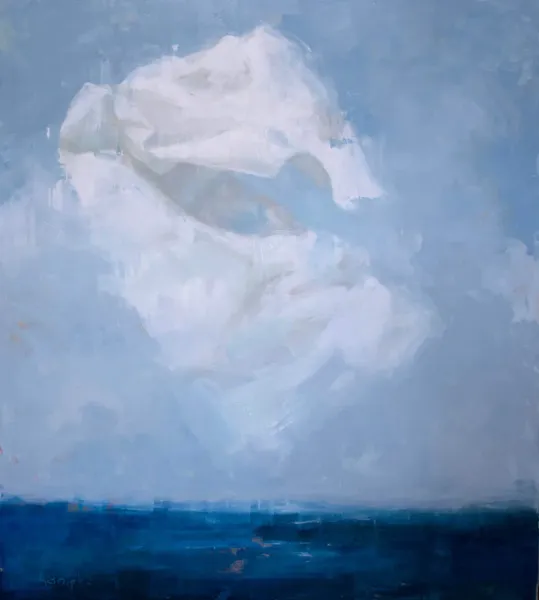
1. Josef Adolphe, A Premonition (2023)
An unidentified form hovers above a seemingly ordinary landscape. Its presence transforms the scene, introducing an atmosphere of anticipation and uncertainty.
This enigmatic encounter lies at the heart of A Premonition, part of Josef Adolphe’s Locutions series. The American painter draws inspiration from moments of personal revelation, those sudden impressions capable of profoundly influencing the course of a life.
The painting’s strength lies in its unresolved narrative. The familiar landscape contrasts with the mysterious suspended object, leaving the viewer to consider what has occurred, or what might be about to happen.
Oil on canvas, 203.2 × 182.88 cm.
2. Elmar Laubender, Coral Cartography (2025)
What appears to be an aerial view of an unfamiliar landscape is, in fact, the surface of a coral photographed underwater.
In Coral Cartography, Swiss photographer Elmar Laubender reveals the intricate structures of marine life. A network of ridges and delicate formations unfolds across the image, its blue and golden tones suggesting the contours of a geological map.
With over thirty years of diving experience, Elmar Laubender has developed a particular interest in the patterns and textures found beneath the ocean’s surface. His close-up perspective transforms minute details into a monumental, almost abstract composition.
Photography, 110 × 170 cm.
3. Malgorzata Krakowiak, Diagram 5 (2009)
Wooden sticks wrapped in black wool become lines in space. In Diagram 5, Polish artist Malgorzata Krakowiak arranges them into two symmetrical vertical elements, creating a wall-mounted composition that moves between drawing, textile and sculpture.
The work’s distinctive character emerges from the relationship between its materials. Wood provides a rigid framework, while wool lends the structure a soft, textured surface. The repeated gesture of wrapping brings the patient labour of textile practice into the construction of a geometric form.
Part of Malgorzata Krakowiak’s Diagram series, conceived as a record of personal meditation, the work draws on the contemplative and geometric principles of the mandala. At over two metres tall, the paired elements give these modest materials an architectural presence. Their measured rhythm and black contours establish a strong graphic composition, inviting attention both to the overall structure and to the fibres covering each individual stick.
Wood and black wool, 215 × 100 × 3 cm.
4. Guenther Baechler, We Did Not Cross the Border, the Border Crosses Us (2019)
During a diplomatic mission in Georgia, Swiss artist Guenther Baechler witnessed the consequences of territorial divisions enforced by Russian border guards. Fences had cut through farmland, separating communities and disrupting everyday life.
These experiences informed We Did Not Cross the Border, the Border Crosses Us, a monumental painting in which political boundaries acquire a physical dimension.
Rusty barbed wire is incorporated into the canvas, while red fissures, applied directly with the artist’s fingers, mark the faces of the figures. These elements convey the distress of communities affected by imposed borders. The visual fragmentation echoes the separation imposed on the landscape, while the title suggests that these divisions extend into the inhabitants’ bodies and minds.
Acrylic and mixed media on canvas, 190 × 230 cm.
Discover We Did Not Cross the Border, the Border Crosses Us
5. Murielle Argoud, Miroir d’eau – nuages (2025)
The changing reflections of water and sky provide the starting point for Murielle Argoud’s Miroir d’eau – nuages, a large-scale diptych whose atmospheric qualities recall Claude Monet’s celebrated Water Lilies.
The expansive horizontal format and fluid treatment of light suggest a landscape without clearly defined boundaries. Using acrylic and mixed media, including a resin-emulsion coating, Murielle Argoud develops a textured surface marked by variations in density and luminosity.
Closely informed by her observation of nature, her painting extends this exploration of water and reflection through a distinctly material approach, where layered textures and colour give substance to fleeting atmospheric effects.
Acrylic and mixed media on canvas, diptych, 100 × 200 cm.
 ZERO COMMISSION
 HAND-PICKED ARTISTS
 GLOBAL ART COMMUNITY
 CUSTOMER SUPPORT
 ARTWORK WARRANTY
 ORIGINAL ARTWORK